Five Things Your First-Party Data Can Already Tell You About a Fan

Colin Chow

Why the Answers Aren’t There Today
Most CROs and CMOs in sports can’t answer basic questions about their own fans. Not because the answers don’t exist. They’re already sitting inside the data these organizations collect every day (ticketing, merch, app, CRM), just locked behind fragmentation. That data is scattered across ticketing platforms, ecommerce providers, app vendors, and agencies, each holding a piece of the picture with none of them talking to each other. Every one of those systems sits between the organization and the fan. There’s no persistent context, and without it, an organization can be sitting on the answer to who a fan is and what they’re worth without knowing it.
Here’s what unlocking that data reveals.
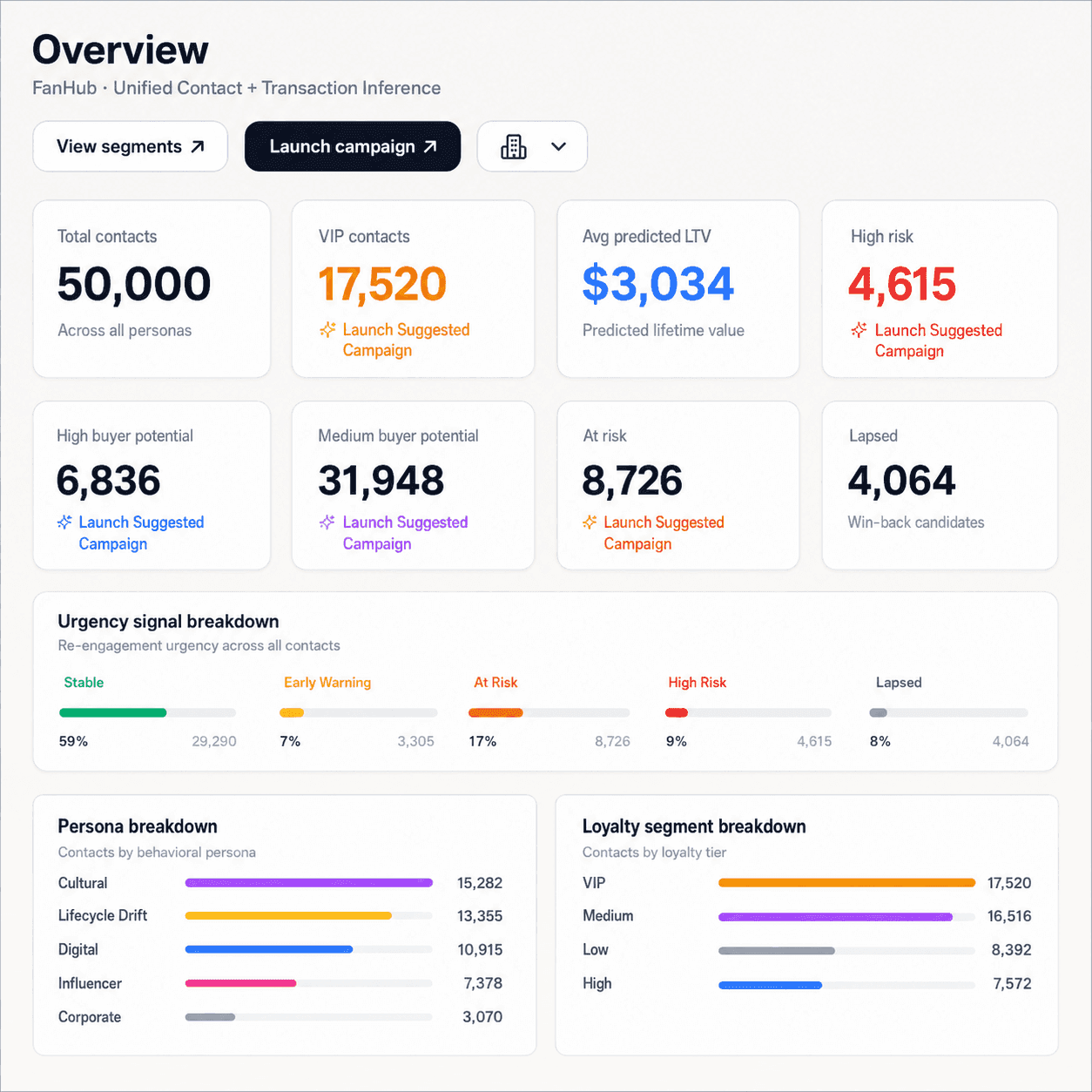
Help me identify and find my future premium buyers.
In a recent study we ran with a university analytics team, fans who would go on to be worth $50,000 or more in lifetime value made up just 0.2% of the base. Standard engagement metrics couldn’t identify a single one of them in advance. Once persona and lifecycle signals fed into the model, identification went from zero to complete.
Most organizations’ first-party data, on its own, isn’t set up to surface a segment like this. It takes reading that same data more completely, beyond basic engagement counts, to see the fuller pattern of how a fan actually behaves, and once that happens, the fans that looked invisible turn out to have been there the whole time.
Tell me who’s about to churn.
A season-ticket holder in year one and a season-ticket holder about to walk look identical on a roster. Both show up as active. Lifecycle stage is the difference between a renewal conversation that starts six months early, while there’s still time to change the outcome, and a renewal notice sent to someone who already decided not to come back.
The same study found an even bigger gap here. Reading fan data more completely nearly doubled the ability to predict lifecycle stage accurately. Churn signal is rarely one dramatic moment. It’s a pattern spread across several smaller behaviors, and most organizations are only set up to see one or two of them.
Where will marketing spend have the highest return.
Most budgets get spent on an average fan, because the organization can’t tell one fan apart from another at the level that matters. Persona and lifecycle data show which segments are worth a personalized offer, which are worth a nudge, and which aren’t worth spend right now, so budget gets allocated across groups instead of spread evenly.
Help my sales team prioritize the right fans.
Marketing spend gets allocated across segments. Sales works one fan at a time, and needs a different kind of signal: which named individual just crossed a threshold worth acting on today, a merch purchase pattern that mirrors past upgrades, a ticket transfer that signals declining interest, a browsing pattern that mirrors a past premium buyer’s. That turns into a ranked list of specific people, with a reason attached to each one.
Increase revenue per fan.
This isn’t a one-time lift. Every fan interaction that gets correctly attributed sharpens the model for the next one, which means the answers to all four questions above get more accurate over time, not just more available. The organizations that start reading their data this way aren’t just capturing revenue they were missing. They’re building a system that gets better at finding it every quarter.
That compounding effect isn’t theoretical. It’s the same dynamic that took premium-buyer identification from zero to complete and nearly doubled lifecycle accuracy in that same study, and it runs on reading what’s already there more completely rather than waiting for more data to arrive.
The Layer That Connects It All
None of this requires new data. It requires a key that unlocks what’s already there. Take whatever first-party data an organization already has and resolve it into persona, lifecycle stage, and lifetime value for every individual fan, not a segment average. That’s what AURA, DataCurve’s identity layer, was built to do: take the fragmented first-party data an organization already owns and resolve it into one persistent view of each fan as a specific person rather than a demographic guess or a segment average.
That view stays connectable across every channel that fan touches. It’s the same mission underneath everything DataCurve builds: stop treating fans as data points scattered across systems, and start treating them as people an organization actually knows.
Most organizations are one layer of interpretation away from these answers. DataCurve is the key that unlocks them.
Want to see what persona, lifecycle stage, and lifetime value would surface in your own fan data? Contact our team to learn more at datacurve.io/contact.
About DataCurve
DataCurve builds fan identity infrastructure for sports and entertainment organizations. At the core is AURA™, DataCurve’s identity resolution layer, which gives organizations a persistent, privacy-safe way to know who their fans actually are, individually, across ticketing, merch, digital, and every other touchpoint, rather than relying on fragmented data and segment averages. DataCurve’s products span fan engagement, fan intelligence, and fan monetization, built on Google Cloud. DataCurve is based in San Francisco.